SolonPort brings 26 years of data expertise to digital port operations
Digitalization in port operations is no longer merely a technology investment; it is becoming a strategic necessity in terms of speed, efficiency, and sustainability.
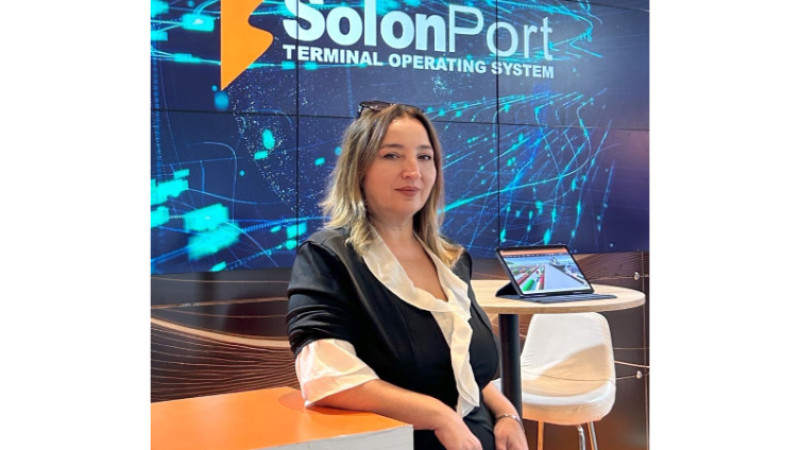

Digitalization in port operations is no longer merely a technology investment; it is becoming a strategic necessity in terms of speed, efficiency, and sustainability. One of Türkiye’s leading port software companies, SolonPort, combines 26 years of field experience with data management, automation, and digital twin technologies to develop next-generation operational management solutions for the port industry. We spoke with SolonPort General Manager Yelda Okşak about the future of port technologies, data-driven operational management, and the impact of digital transformation on the sector.
“Competition is now determined not only by capacity, but by the speed of managing data”
Explaining the concrete advantages provided by the extensive datasets SolonPort has accumulated over 26 years, Okşak said:
“Today, competition in modern port operations is no longer determined solely by crane, yard, or berth capacity; it is also defined by how quickly you can analyze and manage data. Even operational differences measured in minutes can create significant advantages in time, cost, and resource management.
At SolonPort, we combine the field experience we have gained from different port operations over the past 26 years with technology. Thanks to the data generated throughout this process, we can analyze operations faster, adapt more quickly to terminal needs, and make processes more predictable.
Today, data no longer simply represents historical records. When processed correctly, it forms the foundation of operational forecasting, bottleneck analysis, resource optimization, and decision-support mechanisms. By using this approach, we contribute to helping ports establish more controlled, traceable, and sustainable operational structures.”
“We learned port operations not only from screens, but from the field”
Speaking about the key factor that differentiates SolonPort from its competitors in Türkiye’s port software industry and the core element that defines the company as a technology provider, Okşak stated:
“The most important factor that differentiates us is that we are a team that learned port operations not only through software screens, but directly in the field.
Over the course of 26 years, we have had the opportunity to experience different operational models, field dynamics, and the real needs of ports firsthand. This enables us to adapt not only to current requirements, but also to operational risks and changing sector expectations at an earlier stage.
What makes SolonPort a technology company is not simply digitizing existing processes but enabling ports to prepare today for the operational needs they will face in the future, by harnessing the transformative power of digitalization..
Today, speed, integration, data management, and operational visibility have become more critical than ever in the port industry. We shape our solutions around sustainability, flexibility, and high operational adaptability.
“Digital twin technologies are reshaping port operations”
Describing the company’s “digital twin” project developed for ports, Okşak said:
“Digital twin technology is becoming one of the most important topics reshaping operational management in the port sector.
Through our 3D Yard Management infrastructure, which we have been developing for many years, we can monitor and manage operational data at ports in real time within a three-dimensional environment.
Thanks to this structure, ports are not only able to monitor current operations; they can also analyze yard density, equipment utilization, gate operations, and potential bottleneck scenarios in advance, enabling faster and more accurate decision-making.
In particular, increasing operational visibility, optimizing resource utilization, and accelerating decision-making processes are among the most significant contributions of the digital twin approach.
In the coming period, we believe digital twin technologies will take on a far more strategic role, not only in monitoring operations, but also in operational forecasting, scenario analysis, and AI-supported decision mechanisms.”
“Automation in gate and weighbridge operations is now a strategic necessity”
What operational advantages do your automated solutions for gate and weighbridge operations provide?
“Gate and weighbridge operations are among the busiest and most critical processes in ports. Even small delays in these areas can directly impact overall operational efficiency.
Through the automated gate and weighbridge solutions we have developed, most vehicle entry and weighing processes can now be managed with minimal human intervention.
These systems make it possible to increase operational speed, reduce vehicle waiting times, minimize the risk of operational errors, and significantly strengthen occupational safety.
At the same time, making all processes digital and traceable provides ports with greater operational control, while the recorded data greatly facilitates retrospective review and verification processes.
Today, particularly at ports with high vehicle traffic, automation investments are no longer simply a technology preference; they have become a strategic requirement for operational sustainability.”
“We can manage port operations end-to-end”
In which operational processes do you deliver the greatest benefits?
“We approach port operations not from a single point, but with an end-to-end process management perspective.
From vessel berthing planning to yard management, from cargo handling operations to gate processes, we can manage all operational structures within a port in an integrated manner.
Through integration with ministries, customs systems, EDI infrastructures, agencies, customers, transport companies, ERP systems, and financial systems, we are able to feed the entire operational ecosystem with real-time data.
In addition, not only users within the port, but also external stakeholders can monitor live operations and instantly access the data they need through our portal and 3D infrastructures.
Being able to manage different operational layers within the same structure contributes significantly to faster decision-making, stronger coordination between processes, and increased operational visibility for ports.”
“Turkish engineering offers a strong alternative in the global market”
Evaluating their position in the international market and the competitiveness of Turkish engineering in this field, Okşak said:
“In the international market, we position ourselves as a technology company with strong operational know-how, high integration capabilities, and the ability to adapt rapidly to changing requirements.
Today, the core needs of port operations are similar across many regions of the world. One of the greatest advantages of Turkish engineering is its ability to deliver rapid solutions while maintaining a strong balance between cost and efficiency.
At SolonPort, we have completed our European structuring in the Netherlands, creating an organization positioned closer to the international port ecosystem, and we continue to actively expand our global activities.
By combining our 26 years of operational experience with automation technologies, 3D systems, integration infrastructures, and AI-supported approaches, we aim to establish a strong technology alternative in the global market.”
“It is a source of pride to see locally engineered technologies gaining global recognition”
Okşak stated:
“In every project we implement, our main objective has always been to make port operations more efficient, safer, and more sustainable. Today, we actively manage many critical projects in the field, ranging from automated gate systems and 3D yard management to integration infrastructures and digital operational management.
Among the areas where our customers gain the greatest benefits are increased operational visibility, reduced risk of human error, real-time operational monitoring, and faster decision-making processes.
For us, one of the most rewarding achievements is seeing technologies developed through local engineering capabilities gain recognition not only in Türkiye, but also in international markets, while contributing to the competitiveness of our ports.”
“The future of ports will be shaped by data-driven management”
Explaining the innovations SolonPort plans to introduce in port automation in the coming years through the combination of industry experience and technological infrastructure, Okşak concluded:
“In the port sector, the focus is no longer solely on the digitalization of operations; the interpretation of data, predictive capabilities, and the strengthening of decision-support mechanisms are becoming increasingly important.
At SolonPort, we are intensifying our efforts in AI-supported operational management, digital twin technologies, smart yard optimization, autonomous operational infrastructures, and real-time decision-support systems.
Our objective is not only to manage current operations, but also to create more efficient, more traceable, and more sustainable operational infrastructures capable of anticipating the future needs of ports.
We believe that data-driven management will become far more decisive in the port industry in the years ahead. Our goal is to be among the companies developing and leading this technological transformation.”