
Tolga Çakın: FuelEU, a critical turning point for shipowners
The regulation enacted by the European Union is seen as the most critical threshold shaping the future of the sector.

For vessels operating from the Mediterranean basin to Europe, the use of at least 2% green fuel is now mandatory. Shipowners who fail to meet this requirement face heavy penalties of around €640 per ton.
As a solution to the challenges in green fuel supply, the EU has introduced the “pooling system.” In this mechanism, companies with surplus emission rights can sell carbon credits to those falling short, offering early adopters a significant competitive advantage.
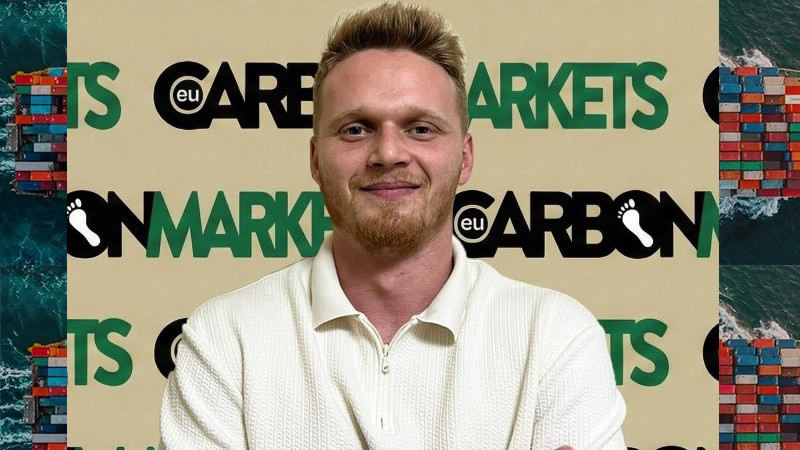
FuelEU is not just a regulation; it marks a turning point that will accelerate fuel optimization, biofuel, and LNG investments. After 2030, companies reducing their carbon footprint are expected to gain price advantages, while those failing to do so will struggle to remain competitive. This new era’s impact on the sector and Carbon Markets’ strategic approach were discussed with Marketing Director Tolga Çakın.
Integrated model in biomass energy and waste management
Tolga Çakın states that the company operates in two main sectors. The first area of activity is a biomass power plant focused on clean environment and waste management. In a project jointly carried out with the Ministry of Culture and Tourism in the Antalya region, all waste from hotels in Belek is collected, incinerated through a special process, and converted into electricity. Carbon Markets is the investor of the facility, established under a Build-Operate-Transfer model. Çakın emphasizes that the biomass power plant has a total capacity of 5.3 megawatts, and highlights that all hotel waste in Belek is both disposed of and utilized for electricity generation. The facility also operates as a producer of voluntary carbon credits.
Strategic investments in logistics and port infrastructure
The company’s second area of activity involves logistics and port infrastructure investments through Medrail Dryport. Developed in cooperation with the Ministry of Transport and Infrastructure, this investment is a key component of Turkey’s national strategy to increase railway transportation.
Çakın points out that in the İzmir Aliağa region, three major ports face serious operational challenges due to insufficient hinterland capacity. To address this need, a large-scale dry port project has been implemented in the area. The facility provides container handling, stacking, washing, internal filling, and chemical cleaning services. It also includes a 10,000 m² closed Type-A bonded warehouse, a 5,000 m² open bonded warehouse, a 35,000 m² container yard, and two integrated railway lines each 450 meters long. This infrastructure is currently serving many maritime companies in the region.
European Union Emissions Trading System and Carbon Credits
According to Çakın’s assessment, the European Union Emissions Trading System stands out as the most decisive mechanism in the global carbon market. Established in 2005, the system was postponed following the 2008 economic crisis but became mandatory for all industrial enterprises within the EU as of 2018. Under the system, each industrial enterprise submits a monthly carbon emission report. For example, if a company produces 10 units of emissions this month and reduces it to 8 units the following month, it is rewarded for the 2-unit reduction. This reward is provided through a digital carbon credit called the European Allowance. Companies with higher emissions are required to purchase these credits. In the EU, one European Allowance trades at around €80, and last year the EU carbon trading volume reached €140 billion.
Mandatory Carbon Payments in Shipping Began in 2024
For the maritime sector, EU carbon regulations officially came into force in 2024. From now on, all vessels over 5,000 GRT operating voyages to Europe must pay carbon emission fees based on their fuel consumption. For each regulated vessel, the total payable emissions are calculated by multiplying the fuel consumed during the voyage by emission factors determined according to the type of fuel used. The EU requires shipowners to cover 50% of emissions for one-way voyages and 100% for round trips. To make these payments, shipowners must use a digital carbon wallet called the Maritime Operation Holding Account (MOHA).
Official Carbon Broker Linked to Europe’s Main Exchange
Carbon Markets operates as a carbon trading company with an official account on Europe’s main exchange, ensuring shipowners can benefit from the system smoothly. The company can directly transfer European Allowances into shipowners’ digital wallets and purchase surplus allowances from them. In addition, it offers flexible options through futures transactions, dealership models, and advanced financial solutions. Çakın emphasizes that to compete with global rivals with over 15 years of experience, they adopt not only a trading-focused approach but also a consultancy-oriented strategy.
Divergence Between the EU and IMO
Tolga Çakın notes that the European Union and the International Maritime Organization (IMO) differ in terms of process management. He highlights that while there have been no postponements within the EU, the IMO has delayed its planned 2028 implementation to 2029. Nevertheless, Çakın underlines that EU regulations carry much stronger global impact.
“A shipowner who ignores carbon cannot survive”
According to Çakın, shipowners who fail to include carbon risk in their cost structures cannot remain competitive. Companies that do not comply with regulations may even be banned from European ports. To stay competitive, investments in low-emission technologies such as fuel optimization, biofuels, and liquefied natural gas are essential. Çakın emphasizes that after 2030, companies reducing their carbon footprint will gain price advantages, while those failing to do so will struggle in the market.
Turkey prepares its own national emissions system
In Turkey, the Ministry of Transport and Infrastructure is preparing a National Emissions Trading System similar to the EU model. The ministry has already passed the necessary law, and regulatory work is ongoing. Once implemented, ships arriving at Turkish ports will be subject to a carbon tax.
Initial studies suggest that approximately €1 billion in annual revenue could be generated. This revenue is planned to be reinvested into the sector through the creation of a green shipping fund. New shipbuilding projects, investments in eco-friendly fuels, and conversion projects will be supported with loans from this fund. Çakın stresses that this process should not be seen as a burden but rather as an important opportunity to prepare for 2030.
Green fuel obligation and FuelEU rules
Carbon Markets currently serves 60 active clients. While shipowners have begun to factor carbon costs into their bidding processes, Tolga Çakın notes that the FuelEU regulation is still not fully understood.
Under EU rules, vessels operating from the Mediterranean basin to Europe are required to use 2% green fuel to reduce greenhouse gas intensity. Companies failing to meet this requirement face penalties of €640 per ton. Due to challenges in green fuel supply, the EU offers shipowners a system called “pooling.” In this system, companies with surplus emission rights can sell carbon credits to those falling short. According to Çakın, shipowners who adapt early to this system will gain significant advantages.
Beyond trading: strategic consultancy
Finally, Çakın highlights that Carbon Markets approaches shipowners not only as a commercial player but also as a strategic partner. He explains that they provide consultancy on all regulatory matters, emphasizing that their goal is not merely carbon trading but also supporting shipowners in building sound long-term financial strategies.