

Aliağa Ports Accounted for 5.5% of Turkey’s Foreign Trade Alone
In 2025, Aliağa maintained its position as a key hub of Turkey’s foreign trade with its industrial strength and port capacity.

Backbone of Aegean Foreign Trade
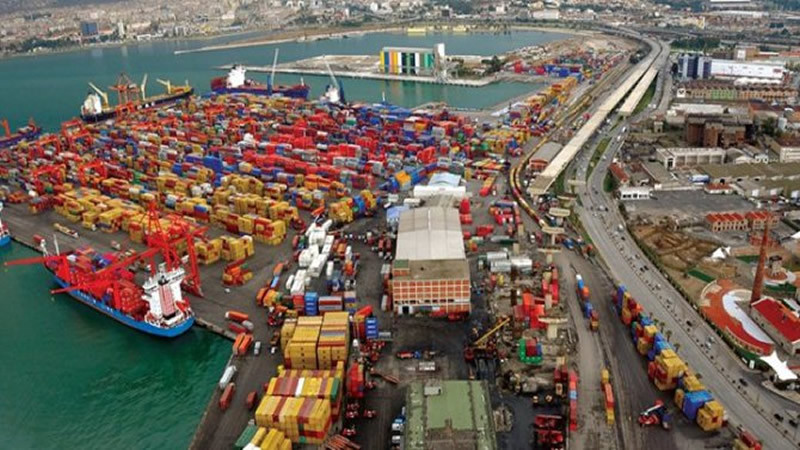
In a period of global trade fluctuations and rising regional risks, Aliağa strengthened its position in 2025 as one of the most critical hubs of Turkey’s foreign trade, thanks to its strong industrial infrastructure, integrated port facilities, and logistics capacity. Becoming the main gateway for industrial production in Western Anatolia—particularly İzmir, Manisa, and Aydın—Aliağa reached a foreign trade volume of 35.311 billion dollars in 2025, continuing to serve as the backbone of the Aegean Region’s foreign trade.
Export Increase, Import Decline
According to data from the Aegean Exporters’ Associations (EİB), exports from Aliağa ports rose by 2.2% compared to the previous year, reaching 21.716 billion dollars in 2025. Meanwhile, imports fell by 7.4% to 13.487 billion dollars, according to the Turkish Statistical Institute (TÜİK). With this performance, Aliağa maintained its rare status as a center consistently posting foreign trade surpluses for nine consecutive years. The export-to-import coverage ratio reached 161%.
Chemicals, Electronics, and Steel Lead Exports
Export figures for 2025 highlighted the sectoral diversity and production strength of the region. The largest share of exports from Aliağa ports came from chemicals and chemical products, totaling 6.3 billion dollars. This was followed by electrical-electronic products at 2.706 billion dollars and steel products at 2.628 billion dollars. These figures demonstrate Aliağa’s strengthening of its high value-added, industry-based export structure.
58% of Aegean, 8% of Turkey from Aliağa
Ömer Ertürk, Chairman of the Aliağa Chamber of Commerce, emphasized the regional and national role of Aliağa ports when evaluating the 2025 foreign trade data. He noted that 58% of the Aegean Region’s total exports and 8% of Turkey’s exports were carried out through Aliağa ports. Similarly, 51% of the Aegean Region’s imports and 3.7% of Turkey’s imports were handled via Aliağa. In total foreign trade, Aliağa alone accounted for 55.8% of the Aegean Region and 5.5% of Turkey.
Leader in Cargo and Vessel Traffic
Ertürk highlighted that Aliağa stands out not only with its foreign trade performance but also with strong figures in port operations. In 2025, total cargo handling at Aliağa ports increased by 3.8% compared to the previous year, reaching 88.699 million tons, securing its position as Turkey’s busiest port region in terms of cargo volume. During the same period, the number of vessels calling at Aliağa ports rose by 2.26% to 6,224, making it the second busiest port region in Turkey after Kocaeli.
Strategic Power in Containers and Liquid Cargo
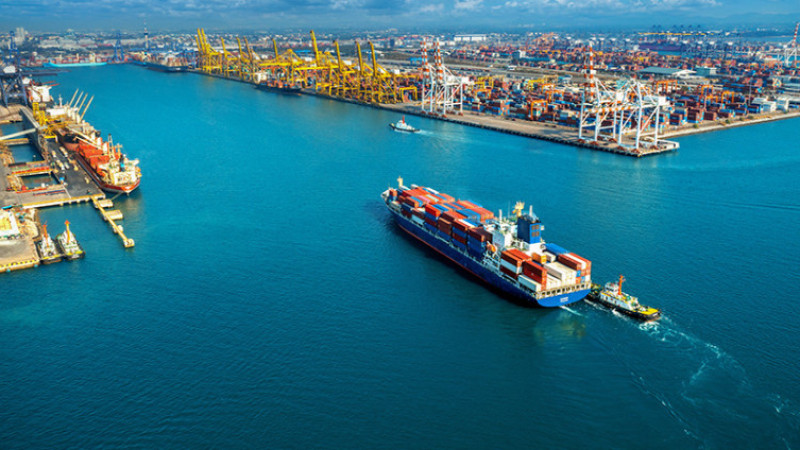
With a container handling volume of 1.701 million TEU in 2025, Aliağa ports ranked among Turkey’s top five port regions. Ertürk noted that the integrated port structure, capable of serving diverse cargo types from containers to bulk and general cargo simultaneously, provides a significant competitive advantage in global trade. Furthermore, approximately 30% of Turkey’s total liquid cargo handling takes place at Aliağa ports, underscoring the region’s strategic role in energy and petrochemical logistics.
Multifaceted Strength in Industry, Energy, and Logistics
Thanks to large-scale investments over the past 15 years, Aliağa has become one of Turkey’s fastest-growing regions. It meets about 25% of the country’s steel demand and nearly 50% of its refined petroleum product needs. In addition to conventional energy production, the region has strong renewable energy capacity with wind and solar investments. Grain storage, warehousing, and logistics services complete the trade ecosystem. Upcoming investments such as Honda’s motorcycle production facility and Nordex’s blade manufacturing plant further strengthen Aliağa’s multi-sectoral economic structure.
Infrastructure as the Key
Despite its strong position, Ertürk emphasized that Aliağa still faces structural challenges. He stressed that sustainable growth requires simultaneous, determined, and coordinated steps from both the public and private sectors. Currently, port areas and heavy industry zones face significant infrastructure deficiencies, particularly in transportation.
Ertürk warned that unless port hinterlands, transport infrastructure, and logistics support areas are addressed with a holistic planning approach, existing potential cannot be fully realized. He underlined that planning must consider the logistics needs of the next 40–50 years. “Fragmented solutions are not enough,” he said, adding that with a shared vision and strong cooperation between authorities and investors, Aliağa’s sustainable growth will accelerate. Supported by proper planning and qualified infrastructure investments, Aliağa’s contribution to Turkey’s economy in industry, production, employment, and exports will continue to increase in the coming years.