

A New Era of Competition: Who Is Better at Managing Volatility?
Global maritime transport is entering a new era shaped by geopolitical tensions, shifting trade routes, environmental regulations, digitalization, and high volatility in freight markets.
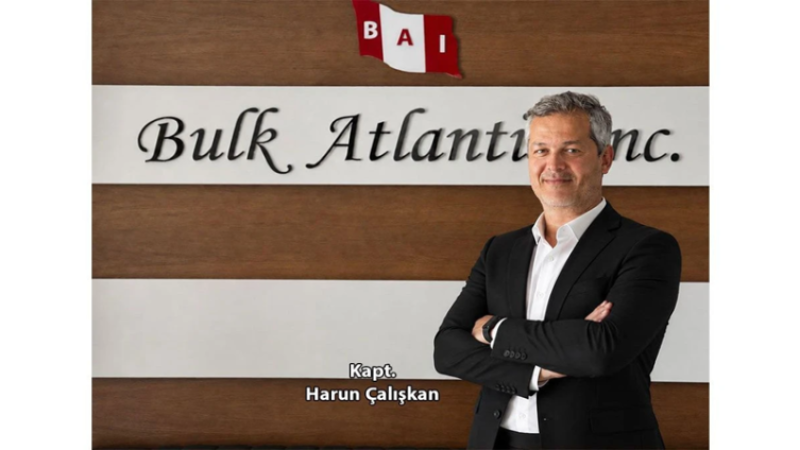

Global shipping is entering a new era shaped by geopolitical tensions, changing trade routes, environmental regulations, digitalisation and high volatility in freight markets. Bulk Atlantic, which has been active in dry bulk shipping, vessel chartering and commercial operations since 1998, views this transformation through the lens of flexible fleet management, modern tonnage, digitalisation and effective risk management.
We spoke with Bulk Atlantic Managing Director Captain Harun Çalışkan about the company's fleet and growth strategy, evolving risks in global shipping, the impact of artificial intelligence on chartering and brokerage activities, the competitiveness of the Turkish maritime industry, and the company's targets for the next five years.
Could you briefly tell us about Bulk Atlantic's founding and its position in the industry?
Bulk Atlantic was founded by Hasan Oktay in 1998. It is an established maritime and ship management company operating in international dry bulk shipping, vessel chartering and commercial operations. Specialising in the transportation of dry bulk and breakbulk cargoes worldwide, our company has a strong and reliable operational structure.
In addition to the vessels we operate on an evergreen basis, Bulk Atlantic maintains a flexible and dynamic operating model through vessels incorporated into its portfolio under both short-term and long-term chartering arrangements. Our operations primarily involve dry bulk vessels across different sizes and capacities, ranging from the Handysize and Handymax segments to the Ultramax segment.
This flexible fleet structure enables us to transport a broad range of commodities, particularly grain products, coal, minerals, fertilisers, scrap metal and various steel products, including coils, sections and pipes.
Could you provide information about the size of Bulk Atlantic's current fleet, its carrying capacity and approximate current fleet value? Do you have any plans to expand the fleet through new vessel acquisitions or investments in the coming period?
Our business model is based on a flexible chartering and operational strategy that enables us to adapt quickly to market conditions. Accordingly, our total fleet size and market value may vary depending on fluctuations in the spot freight market, prevailing chartering conditions and the volume of existing contracts. This structure allows Bulk Atlantic to closely monitor market opportunities and optimise its fleet capacity and operations in line with market dynamics.
In line with the global shipping industry's efforts to reduce carbon emissions and achieve environmental sustainability, we prioritise modern, low-carbon-footprint vessels featuring eco-design characteristics in our operations. Through investments in modern tonnage, we aim to improve operational efficiency while strengthening our ability to comply with evolving environmental regulations.
Our growth strategy centres on further advancing our expertise in key commodity groups and industrial dry bulk transportation. In this context, we are particularly focused on incorporating modern vessels from relevant tonnage segments that offer flexible routing and operational capabilities, supported by long-term and stable contracts.
We are also closely monitoring new strategic partnerships, periodic vessel acquisition opportunities and suitable chartering alternatives to expand our operational network and market access. By combining our extensive industry experience with flexible fleet management and market-oriented commercial strategies, we aim to achieve sustainable and controlled growth.
Geopolitical risks, wars and freight market volatility continue to affect global shipping. What do you believe will be the biggest opportunities and risks facing shipowners and shipbrokers in the coming period?
The central question for the shipping industry in the coming period will no longer be simply, "Are freight rates high or low?" The real issue will be how volatility in the freight market is managed. Recent developments indicate that high volatility is no longer a temporary market anomaly but has become an important part of the industry's new normal.
In the past, supply and demand were the primary factors used to analyse shipping markets, while other variables were considered secondary. Today, however, it is becoming increasingly difficult to explain market conditions solely through supply and demand. Geopolitical risks, wars, droughts caused by climate change, fluctuations in agricultural production, energy policies and the reshaping of trade flows are directly influencing freight markets.
The increase in tonne-mile demand resulting from geopolitical developments could represent one of the major opportunities for shipowners in the coming period. When wars or political tensions force vessels to take longer routes, demand for shipping capacity increases even if the physical volume of global trade remains unchanged. Longer routes also reduce the number of voyages a vessel can complete within a year, creating additional demand for existing fleet capacity.
However, an important risk lies in shipowners treating high freight rates as permanent and responding by placing excessive orders for new vessels. A cycle of strong investment and ordering similar to the one experienced from the early 2000s through 2008 could emerge again under different conditions. For this reason, the key question for a shipowner should not be, "At what freight rate can I operate this vessel today?" but rather, "Under what freight rate, cost and regulatory environment will I be operating this vessel through 2030?"
This transformation is also changing the role of shipbrokers. Traditionally, a broker's primary function was to match the right vessel with the right cargo and accurately assess market prices. In the future, however, brokers will increasingly be expected to provide analysis and decision support on operational and geopolitical risks, in addition to freight pricing.
When evaluating a voyage, war risk insurance, sanctions regimes, insurance coverage, fuel availability, alternative routes, transit times and potential delays at ports must now be analysed together. The Russia-Ukraine war and developments in the Gulf region have demonstrated how quickly war risk insurance costs can change. We are therefore entering an era in which we price not only the market but also the risk.
We believe that one of the most significant structural risks over the next five to ten years will be chokepoint risk. The Suez Canal, Strait of Hormuz, Bab el-Mandeb Strait, Panama Canal, Strait of Malacca and Turkish Straits are no longer merely geographical passage points; they have also become important components of the global freight market's pricing mechanism. Any security or operational disruption at one of these critical locations could directly affect global vessel supply, tonne-mile demand and freight rates.
Another important distinction will emerge between older vessels and modern, efficient tonnage. In the coming period, fleets will be valued not only according to their deadweight tonnage (DWT) capacity but also on the basis of fuel consumption, EEXI and CII performance, emissions profiles, energy efficiency, digitalisation capabilities, maintenance history, insurability and risk assessment criteria. As a result, the economic value of two vessels with the same DWT capacity may differ significantly.
In conclusion, we believe the shipping industry is not moving towards a return to normality but rather entering a new era in which high volatility is accepted as the norm. The most successful shipowner in the coming period will not necessarily be the one securing the highest freight rates, but the one who prices geopolitical risks accurately, prepares the fleet for technological and environmental transformation, allocates capital to the right vessels at the right time, preserves liquidity and remains flexible across different market scenarios.
Similarly, the role of a successful broker will extend beyond securing freight. It will increasingly involve interpreting market, operational, geopolitical and financial risks together and providing clients with comprehensive decision support.
Digitalisation, artificial intelligence and sustainability are now indispensable topics in the shipping industry. How is Bulk Atlantic preparing for this transformation, and what investments are you making?
Looking back, we see that transformations in the shipping industry have generally been gradual and long-term processes. Compared with many other sectors, shipping still has a largely analogue structure. One of the main reasons is that the industry is a large and complex ecosystem involving numerous layers and stakeholders.
However, we believe digitalisation has moved beyond being an option and has become a necessity. The key issue is the infrastructure, standards and strategic approach through which this digital transformation will be implemented.
Developments in artificial intelligence and sustainability will directly affect all stakeholders across the shipping industry. We believe chartering activities, traditionally based on telephone conversations, confirmation processes and strong intuitive market knowledge, will evolve towards a new advisory model that is data-driven, technology-integrated and incorporates sustainability criteria.
The most important transformation in the coming period will be the shift from decision-making based on the experience of brokers or charterers towards a "human + data + artificial intelligence" model.
We do not believe artificial intelligence will completely replace human involvement. On the contrary, we believe it will create a powerful decision-support mechanism that complements commercial judgement with data in processes such as market screening, tonnage position analysis, freight forecasting, voyage estimation and carbon cost calculations.
For this reason, we believe digitalisation should cover the entire pre-fixture, fixture and post-fixture process. When implemented correctly, digitalisation will accelerate decision-making, improve operational efficiency and reduce the margin for error.
We are continuing to invest in making maximum use of our existing technological infrastructure, developing simulations that reflect actual market conditions and integrating data into our commercial decision-making processes.
Türkiye has significant advantages in maritime trade thanks to its geographical location. In your view, which areas need to be developed to strengthen the international competitiveness of the Turkish maritime industry?
Türkiye occupies a unique geostrategic position at the crossroads of Europe, Asia and Africa. It also controls globally strategic maritime passages, including the Istanbul and Çanakkale Straits, which connect the Black Sea to the Mediterranean. However, to fully translate this potential into economic value, Türkiye needs to move beyond being merely a "bridge" or transit country and pursue a regional hub model offering high-value-added logistics and maritime services.
Thanks to investments made over the past 20 years, the Turkish-owned fleet has reached a significant scale in global maritime trade. The next stage should focus not only on total tonnage but also on improving fleet quality. Renewing the fleet in terms of average vessel age, technological infrastructure, energy efficiency and economic value should be a priority for maintaining competitiveness.
Türkiye's port infrastructure must also be approached from a perspective that prioritises efficiency and technology, rather than capacity expansion alone. Supporting ports with digitalisation, automation, artificial intelligence and data management technologies, strengthening their integration with rail and road networks, and developing intermodal transport infrastructure are all critically important.
The green transition should not be viewed solely as a compliance requirement or cost factor for Türkiye, but also as an opportunity to create a competitive advantage. Alternative fuel infrastructure, energy-efficient vessels, green ports, carbon management, emissions-reduction technologies and next-generation applications such as Green Shipping Corridors will be key components of this transformation.
Turkish shipyards should also develop expertise not only in shipbuilding but also in green technologies, retrofit applications, alternative fuel systems and advanced maritime technologies.
Developing a skilled workforce and strengthening research and development capacity are equally critical to ensuring that this transformation is sustainable. Stronger cooperation between universities, shipyards, shipowners, port operators and technology companies would help position Türkiye as a technology-developing country in fields such as artificial intelligence, digital twins, autonomous systems, energy efficiency and operational optimisation.
Access to long-term financing at competitive costs is another fundamental requirement for achieving these goals. The use of alternative financing models and instruments such as FFAs (Forward Freight Agreements), which are used to manage freight and market risks, should be encouraged and made more effective in Türkiye. Combining appropriate public incentives with private-sector investment and financing opportunities would accelerate the industry's transformation.
In short, Türkiye should not view its geographical advantage solely as a transit advantage. Instead, it should support this advantage with technology, the green transition, a skilled workforce, strong financing models and high-value-added maritime services. This would enable Türkiye to become not only a regional logistics hub but also a leading and preferred centre for international maritime services.
Where do you see Bulk Atlantic over the next five years? Could you share your plans for new markets, investments and the company's goals for the industry?
Over the next five years, Bulk Atlantic aims to strengthen its strategic structure in response to rapidly changing market dynamics and the reshaping of global maritime trade corridors. We also aim to achieve our digitalisation and decarbonisation targets as quickly as possible.
In line with the IMO's emissions targets, we will prioritise modern, environmentally friendly and fuel-efficient tonnage for long-term inclusion in our fleet. We aim to strengthen our presence across our existing vessel segments while increasing our operational flexibility.
While maintaining our strong market position in the Mediterranean and Black Sea basins, we plan to expand our operational volume along emerging trade corridors worldwide. Deepening our direct relationships with major producers and suppliers and developing long-term, contract-based business models are also among our priorities.
In terms of digitalisation, we will make more extensive use of data analytics, advanced route optimisation software and digital tracking systems to reduce fuel consumption and operational costs.
To balance volatility in the spot freight market, we aim to build a resilient portfolio capable of withstanding changing market conditions by integrating short-term and long-term contracts with financial derivatives.
Our primary objective over the next five years is to establish a sustainable, scalable and competitive growth model that capitalises on market opportunities at the right time, manages risks effectively, adapts rapidly to technological and environmental transformation, and strengthens our presence in international markets.