

Hapag-Lloyd’s acquisition of Zim an era defining moment
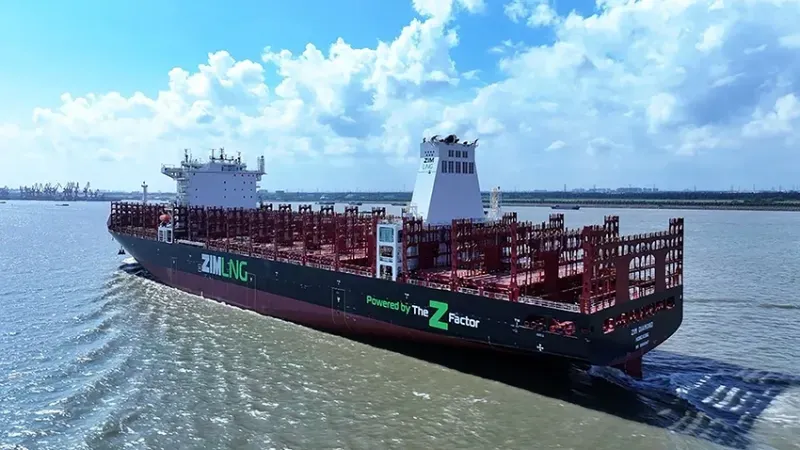
Hapag-Lloyd’s $4.2 billion deal to buy Zim is the beginning of the end of the container shipping’s age of consolidation as the top carriers vie for market share.

More than 20 years ago, the late great Containerisation International writer John Crichton was mulling over which six carriers would remain after the container shipping market consolidated.
Maersk and MSC were top of the pile, Cosco and a South Korean line would both have government backing, and after that Evergreen and probably Hapag-Lloyd.
As the consolidation of the market approaches its denouement with the German carrier consolidating its fifth position in the pecking order, following the scooping up of the tenth largest carrier in Zim, the container seer’s vision is taking shape nicely.
With the barriers to entry now very high, achieving a top ten billing will be tough, and will need the backing of a state such as India which is investing billions of dollars into the Bharat Container Shipping Line (BCSL), a strategic provision to boost its emergent export market.
Yesterday, Hapag-Lloyd CEO Rolf Habben-Jansen explained some of the reasoning behind the acquisition of the Israeli carrier, with the German line essentially buying 99 vessel charter contracts and some service synergies.
Market share gains
The most significant of these is the leap from sixth place in market share to equal third, with Ocean Network Express (ONE), in the lucrative transpacific market, while also increasing its market share in the Atlantic, intra-Europe and intra-Asian markets.
Hapag’ Lloyd’s grab of market share in the US trades taking 12% of the Pacific business, up from 7%, and 27% of the Atlantic freight, a 3% increase.
Would the Crichton of today see this as a wise move?
Undoubtedly Hapag-Lloyd will increase its revenues and income, however, the greater investment into the American market comes just as the shift in the focus of the container shipping market, which has been moving east for more than 20 years, took decisive steps this year with the inception of BCSL and the Trump administration’s protectionist policies.
No decision on the future of Gold Star Line (GSL), Zim’s Hong Kong based sister company, has been made, but with the US policies focused on China, reshoring of factories to other Asian markets, will boost the mainly intra-Asian services operated by GSL, and will also offer Hapag-Lloyd and its Gemini partner greater coverage in this emerging market too.
Expected synergies from the merger
Synergies will boost Hapag-Lloyd’s income, according to the German company’s CEO, with savings of up to $500 million, through network efficiencies, procurement and digital collaboration raising profits.
At face value the combined revenue for 2025 of Zim and Hapag-Lloyd is estimated at $28 billion, with $2 billion in profits, Zim’s contribution to that income would be $6.9 billion and $700,000 respectively.
Rarely, however, will the merger of two companies add up to a combined revenue that totals 100% of the companies’ separate income, as Crichton would no doubt have pointed out to Habben-Jansen.
Further synergies will exist on the east-west trades for the Gemini Cooperation, however, with charter rates high and Zim seemingly tied into some long-term charters that will be of concern as the Pacific heads into contract negotiations in a depressed US market with disgruntled shippers that have been paying historically high freight rates.
Habben-Jansen’s assertion that chartered tonnage “gives you more flexibility”, allowing the carrier to adjust your cost base than if you don’t have a lot of charter tonnage. "Having said that, if this transaction is completed, then the percentage of chartered tonnage is a little bit on the high side, so over time we expect to bring that down," he said.
Operational cost cutting will need to be where the savings are realised given that Habben-Jansen, acknowledged a reduction of employment over time, but ruled out high levels of redundancies in the short-term, pointing to the acquisitions of CSAV and UASC, in 2014 and 2017 respectively, which still have similar levels of employment.
New Zim
Approvals for the deal are now awaited from shareholders, with that meeting to discuss the offer coming next month, while regulatory approvals, including from the Israeli government, are expected to be completed by the end of this year.
Tel Aviv’s approval will be key, with the Haifa Mayor, Yona Yahav, vehemently opposed to the sale as concerns of Israeli security and job losses were voiced.
According to Israeli media the two companies have attempted to ameliorate opposition by creating the New Zim owned by private equity fund, FIMI which will operate the Israeli-focused activity, including 16 vessels owned by Zim; three trade routes, two intra-Asia services and one Israel to US East Coast service; the company’s Haifa headquarters and the rights and obligations stemming from the state’s golden share.
New Zim will, reportedly, operate, “A minimum number of owned vessels so that in wartime, when foreign ships do not arrive, the state can deploy and requisition ZIM’s fleet to transport ammunition, wheat and fuel to Israel.”
The Golden share also requires the company’s headquarters remain in Israel. “In effect, through the acquisition of ZIM’s Israeli operations, FIMI will establish a new maritime transport company — the “New ZIM” — which will gain access to Hapag-Lloyd’s global network,” it was reported locally.
It is probable, though not explicitly advised, that the ro-ro vessels in the Zim fleet, around 15 ships, will be transferred to New Zim with the strategic element of the company likely to require such tonnage. And Hapag will for an unspecified amount of time, offer slots to the newly formed carrier.
FIMI will begin operations with three services, two intra-Med services and one to the US East Coast.
Hapag-Lloyd will sail away with a consolidated income and greater market share. Will the German line survive as one of John Crichton’s half dozen mega carriers? Most likely. But maybe the soothsayer may have adapted those predictions a little for the modern day.