



Turkish Shipyards Face New Order Challenge Despite Export Record
Türkiye’s shipbuilding industry expects exports to reach a record $2.5 billion this year, but weakening competitiveness and a slowdown in new contracts are raising concerns for shipyards heading into 2027 and 2028.
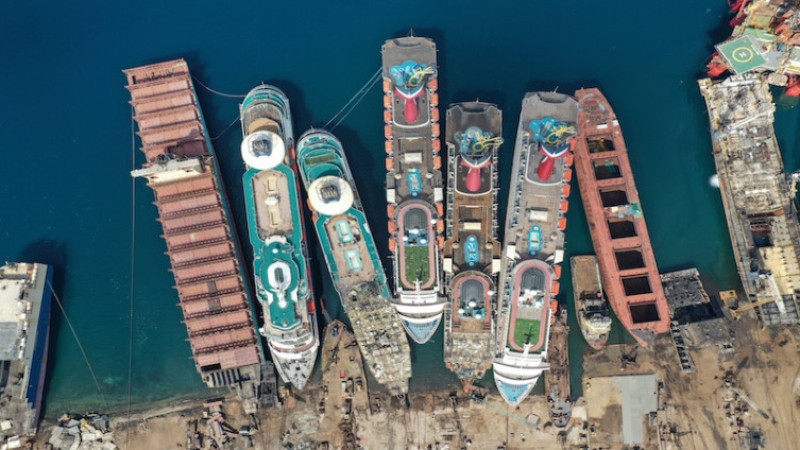

Türkiye ranks 12th globally in shipbuilding. However, the picture differs somewhat when it comes to export value per kilogram, according to data from the Ministry of Trade. In this context, the sector’s average export value per kilogram stands at around $25. Based on overall export value and volume, Türkiye ranks 10th in the world, while it is the world’s second-largest producer of mega yachts after Italy and ranks first globally in the production and export of fishing vessels. Looking at the data, one of the most significant turning points behind the sector’s rise to this position was the 2008 financial crisis. The Turkish shipbuilding industry underwent a major transformation during this period, shifting towards more sophisticated and high-value projects and securing an important position in key markets, particularly Northern Europe. As recently as four years ago, around 35% of these orders were being placed with Turkish shipyards. Today, however, there is a risk that two decades of accumulated progress could be lost, according to Mustafa Talha Pepe, Chairman of the Board of the Ship, Yacht and Services Exporters’ Association (GYHİB). Pointing out that some shipyards have been unable to sign new contracts for the past year, Pepe said, “We simply expect the exchange rate to increase in line with inflation.”
“We expect a record this year, but 2027 and 2028 do not look promising”
Speaking to Ekonomim’s Barış Sedef, Pepe emphasized that shipbuilding projects are long-term in nature. “Many of the projects currently under construction at shipyards were secured one or two years ago. The delivery and contract completion periods for these projects are coming to an end this year, and we expect the sector to achieve a record in exports. However, 2027 and 2028 do not currently look very promising. In particular, the stability of the exchange rate is negatively affecting our sector in terms of securing new orders and maintaining competitiveness,” he said.
“Approaching customers with old prices would be suicidal”
Stating that Turkish shipyards have lost part of their competitive edge, Pepe said: “Approaching our customers with the prices we offered in the past would be suicidal. As a result, we have lost our competitiveness when bidding for new projects. At the same time, we are now making losses on contracts secured in previous years. As an industry, we are caught in a complete squeeze, and this situation is putting enormous pressure on our shipyards.”
Highlighting Spain as Türkiye’s biggest competitor in Northern Europe, Pepe said: “Spain is currently 20% cheaper than us. Three or four years ago, we were on an equal footing, but with today’s costs, we have become 20% more expensive. Six years ago, however, we were 15% cheaper than Spain.”
“European owners are satisfied with our custom-built vessels and quality”
Pepe noted that countries such as South Korea, China and Japan operate on a much larger scale and dominate high-volume shipbuilding projects. “Due to regulations in the United States, accessing that market is difficult. This makes markets such as Canada and Northern Europe more attractive for shipyards that can stand out through niche and specialized vessel construction,” he said.
Emphasizing that European shipowners value Turkish shipyards, Pepe added: “We can retain this market if we are able to offer our customers competitive prices. Europeans are satisfied with us when it comes to custom-built vessels and quality.”
Pepe also pointed out that Turkish shipyards have not passed their rising costs on to European clients for projects already under construction. “Even on projects where we are making losses, our companies continue their work by prioritizing continuity. What matters most is securing new projects for our shipyards,” he said.
Commenting on year-end export expectations, Pepe stated: “We expect exports to reach $2.5 billion by the end of the year. More than 90% of this figure will come from projects contracted in previous years and reflected in this year’s deliveries.”
“No shipyards have closed, but mergers are on the agenda”
Despite the slowdown in new orders across the shipbuilding industry, Pepe stressed that no shipyards have closed so far. “However, mergers and acquisitions are on the agenda within the sector. Some shipyards are facing difficulties, but the situation has not yet reached the point of closures. The industry is continuing to move forward through its own dynamics, and our goal is to overcome this period without significant losses,” he said.
Pepe also described the Ministry of Energy and Natural Resources’ approach toward the development of offshore wind energy platforms as valuable. “These projects may take time to materialize, but Turkish shipyards are ready to contribute to such developments. Our shipyards have already left their mark on a wide range of projects, from bridges to large-scale marine structures,” he said.