


A Turkish Broker in Rotterdam: Seren Sapmaz
Seren Sapmaz, a Ship Sale & Purchase (S&P) Broker at Friday & Co Shipbrokers BV, discusses her career journey and the changing dynamics of the global maritime market.
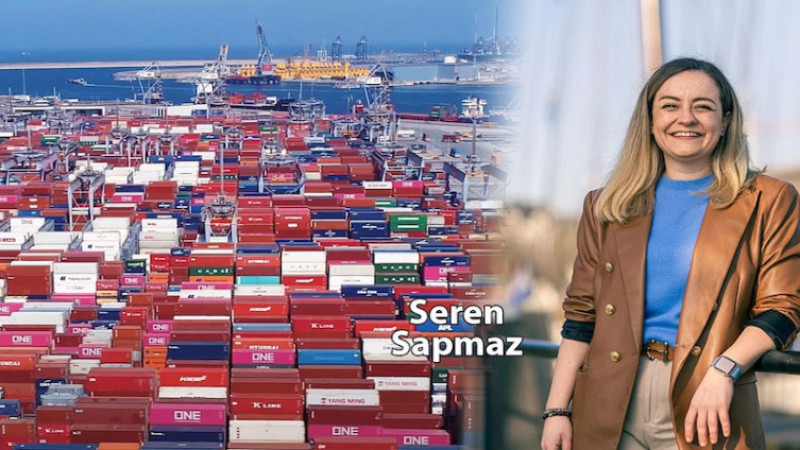

Friday & Co Shipbrokers BV Ship Sale & Purchase (S&P) Broker Seren Sapmaz’s interest in the maritime industry began during her years at law school in Istanbul, through summer internships at law firms specializing in maritime law. She describes those days as a period when she was counting down the days to enter professional life, excited by the opportunity to meet new people and companies and learn the unique dynamics of the maritime industry. Her years as a lawyer enabled her to combine both the legal and practical, field-based aspects of the industry.
Recalling one particular experience from that period, she says: “One day, I would be reviewing a newbuilding contract between a Turkish shipowner and a Japanese shipyard, and the next morning, I would head to the Gulf early to join shipbuilding engineers during an on-site inspection to assess the value of unfinished vessels at a shipyard. On my return, I would be waiting for the Bill of Sale together with the buyer at the closing meeting of a sale and purchase transaction.”
Having also been involved in ship finance projects with numerous Turkish and international banks, Sapmaz emphasizes that negotiating contracts taught her the “commercial perspective,” which can sometimes be perceived as the complete opposite of law. As her portfolio and network expanded, she met her current company in the Netherlands, where she had gone for her master’s degree, and has continued her career as an S&P broker there for the past three and a half years.
Boutique Expertise in Rotterdam and an “Off-Market” Strategy
Friday&Co, where Sapmaz works, is a boutique shipbroking company that has been active in the Sale & Purchase market for more than 20 years, with offices in Rotterdam and Riga. Although its core specialization is coaster tonnage, the company has also become active in larger vessel segments in recent years as customer demand and vessel sizes have increased. Despite being headquartered in the Netherlands, the company has an international and dynamic team focused on different markets and segments. Within this structure, Sapmaz primarily serves shipowners from Türkiye, the Netherlands and the Eastern Mediterranean.
The company’s biggest advantage in the market is its customer-focused “off-market” approach. Rather than simply circulating a vessel in the market when necessary, the company generally prefers to identify the target buyer or vessel precisely and establish direct and private communication. Its long-standing relationships with a large proportion of shipowners across the European market allow clients to establish contact with minimal intermediaries or directly with the buyer or seller. The company has a particularly strong portfolio of European-built coaster vessels.
Data strength is another important asset for the company. Sapmaz says that, through their joint venture with Sea3R, they provide European banks with monthly and annual vessel valuations for ships in their portfolio. In addition, their market reports covering 3,600, 5,000, 6,500 and 8,500 dwt coaster vessels support their operations with extensive market and pricing data.
The Pandemic Turning Point and Two Different Cultures at the Table
For Sapmaz, the idea of pursuing an international career gained momentum during the pandemic, when she began looking for an additional area of specialization within the maritime industry. The Netherlands, being at the heart of the European maritime world, provided an exceptional opportunity to build a commercial and operational perspective on top of her legal background. Working in an international environment taught her how to establish a balance by taking cultural differences into account while acting as an intermediary.
“At a table where there is a seller who wants to sell their vessel and an interested buyer who wants to acquire the vessel at the ‘best possible’ price, you are actually managing two different commercial cultures, two different languages of expectations and, in many cases, two different perceptions of risk at the same time. Every vessel teaches me something new, both technically and commercially.”
This international perspective also enables her to follow the Turkish market as well as the North European and Baltic freight markets firsthand and closely monitor S&P trends.
Changing Routes in the Ship Sale & Purchase Market: From Coasters to Larger Tonnage
Assessing current market conditions, Sapmaz identifies the strategic shift among Turkish shipowners as one of the most notable recent trends in the coaster segment. Turkish shipowners, who showed strong demand for small coasters after the pandemic, have increasingly turned towards larger tonnage due to weak freight markets, rising OPEX costs, crew shortages and difficulties in accessing finance for smaller vessels.
In Europe, particularly in the Netherlands and Germany, the picture is the opposite. Rather than increasing vessel size, shipowners are choosing to expand their fleets with more economical vessels.
Selectivity regarding older vessels has also increased. Due to the challenges associated with IACS-class societies and flag-state requirements, interest in vessels built before 2000, except for those operating on the Black Sea trade, is gradually declining.
In larger tonnage segments, fluctuations in bunker prices are directing buyers towards vessels built after 2013, equipped with Tier III-compliant and eco-design engines. This has further widened the price gap between older and newer vessels. Likewise, global trade policies directly affect the price differential between Japanese-built and Chinese- or Korean-built vessels.
Sapmaz notes that vessel prices are determined not only by recent sale and purchase transactions, but also by age, condition, newbuilding prices, delivery times, available tonnage supply in the market and scrap values. She summarizes the overall S&P market as follows:
“The S&P market has not been moving in parallel with the freight market for a long time. The Russia-Ukraine war, uncertainty in the Middle East and rising costs have not yet given buyers sufficient confidence for new investments. For shipowners whose vessels are no longer accepted for class by IACS member organizations due to their age, purchasing a vessel younger than 25 years may appear to be the only option, but current market and financing conditions do not really support this.
“Moreover, the fact that very few new vessels were built in Europe for years following the 2008 crisis has created a shortage of vessels aged between 10 and 20 years in the existing fleet. This has caused prices to soften more slowly than expected. The continued rise in newbuilding costs both in Europe and the Far East is another major factor that should not be overlooked.”
Technological Transformation: Autonomous Ships and the Three Originals of the Bill of Lading
The wave of digitalization and artificial intelligence transforming the maritime industry is also a subject that Friday&Co has been focusing heavily on over the past year. Rather than resisting these new technologies, Sapmaz and her team are exploring how they can be used to match the right vessel with the right buyer and reduce the daily operational workload. The number of AI agents integrated into the systems they use on a daily basis has increased dramatically over the past year.
However, she also observes that the industry remains traditional and resistant to innovation due to its inherent structure. Sapmaz, who wrote her master’s thesis on smart contracts, points out that the maritime and transportation industries are among the sectors that have been slowest to adopt artificial intelligence.
“Autonomous vessels no longer surprise anyone, yet we are still an industry where business is conducted using three original bills of lading and physical paperwork,” she says. While she expects technology to reduce the number of intermediaries such as agents, brokers and customs brokers, she argues that AI will not be able to completely replace trust-based human relationships, at least in the near future.
Valuable Advice for Young Lawyers and Aspiring Brokers
At the end of the interview, Sapmaz addressed young people seeking to build their careers in this field, emphasizing that the key to success lies in learning how to understand people and persevering. She notes that accessing information has become extremely easy, but gaining expertise by applying that knowledge in practice requires patience and consistency, often through trial and error.
For candidates without a background in maritime studies or marine engineering, she particularly recommends completing the examinations of institutions such as the Institute of Chartered Shipbrokers (ICS), which also has a branch in Türkiye. She says that such accreditations provide international credibility, whether one works as an S&P broker or a chartering broker, while also opening the doors to a vast professional network with thousands of members.
Sapmaz has been a member of the Women’s International Shipping & Trading Association (WISTA Türkiye) since the beginning of her professional career. After moving to the Netherlands, she also joined WISTA Netherlands and actively participates in events in both countries.
Sapmaz concludes with a warm message to young professionals, emphasizing that their efforts will not go unrewarded:
“As long as they see their work not as an obligation but as something they genuinely enjoy, they will never walk this path alone. As someone who has personally experienced the support and solidarity within the Turkish maritime industry, both at home and abroad, I can say that our industry is much closer and more supportive than people might think. As long as they remain patient, continue learning new things and never stop improving themselves.”