
The U.S. Greenland Move Highlights the Arctic Route: Trade Balance May Shift
U.S. President Donald Trump’s statements about bringing Greenland under U.S. control have once again brought to the forefront the growing strategic importance of the Northern Sea Route (NSR) in global trade competition.
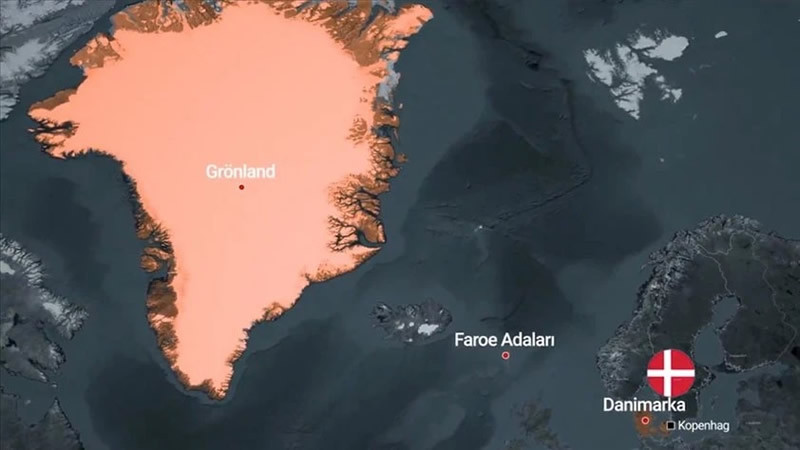

With climate change opening new sea lanes, the search for alternatives to the Suez and Panama canals has accelerated.
Since taking office, President Trump has openly emphasized his strategic goals regarding Greenland, increasing debates about trade and security balances in the Arctic. With its strategic location, Greenland is critical for the U.S. ballistic missile early warning systems, while also standing out for rare earth elements, critical minerals, and energy resources expected to become accessible as glaciers retreat.
Trump’s move is seen not only as an effort to strengthen U.S. military and political presence in the Arctic but also as a reflection of the growing competition over Arctic sea routes that could play a key role in the future of global trade. In recent years, accelerated ice melt has allowed longer navigation periods in the Arctic Ocean, making alternative routes that shorten the distance between Asia and Europe more attractive.
Northern Sea Route Provides Distance and Time Advantage
A study titled “Changing Oceans and Maritime Transport: New Routes and Geographical Feasibility in the Arctic Region” by researchers from Istanbul University’s Institute of Marine Sciences and Management and Dokuz Eylül University reveals that the NSR shortens travel time and reduces costs in transportation between Europe and East Asia.
According to the research, Arctic sea ice has decreased by more than 75% since 1979. This has made the NSR more accessible, with calculations showing that sailing time on the Europe–Asia line could be reduced by about 40% compared to traditional routes. While NSR offers significant advantages for northern and eastern ports, the Suez Canal is still considered more favorable for southern endpoints such as Singapore.
Distance Comparisons from European Ports to Asia
The study found that voyages from the United Kingdom’s Felixstowe Port to northern Asian ports such as Shanghai, Busan, and Yokohama via the NSR are thousands of nautical miles shorter compared to the Suez route. On the Yokohama–Hamburg line, nearly all of the 39 scenarios tested with different ship types and speeds showed NSR’s superiority in terms of time and cost.
In Some Scenarios Costs Drop by Half
Depending on ship type, speed, and icebreaker support, NSR can reduce costs by up to half in certain scenarios. When ice-class vessels can navigate without icebreaker assistance, time and cost efficiency reach their highest levels. If ice conditions improve further, the Transpolar Sea Route is expected to be completed even faster than the NSR.
Challenges and Risks
Despite the distance and time advantages, experts point out that NSR still faces serious logistical challenges, including harsh climate conditions, limited port infrastructure, the need for icebreakers, and high insurance costs. All these factors highlight why Greenland, the world’s largest island, is becoming increasingly important in Arctic trade and in U.S. strategic calculations.